
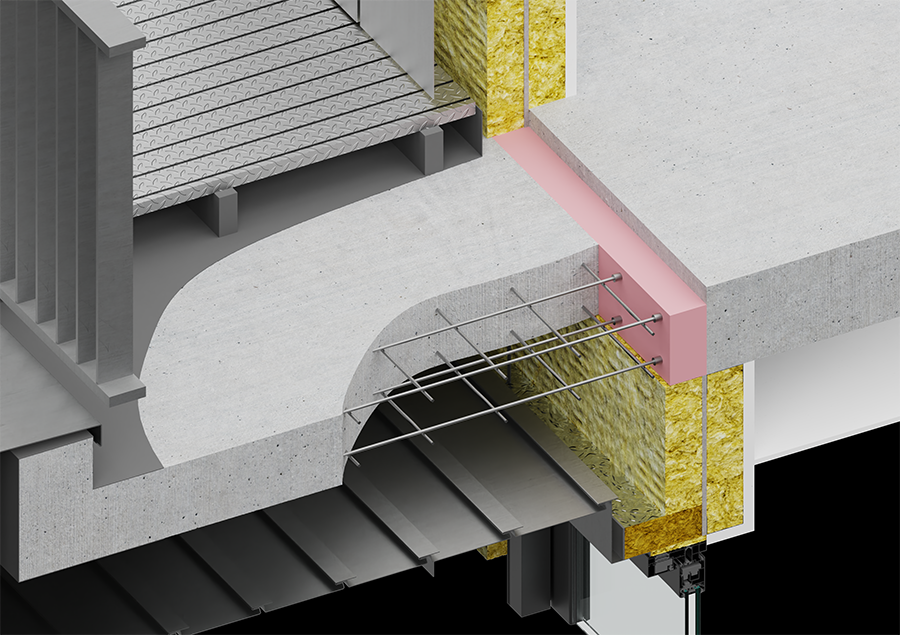
Thermal Bridging in Façade Systems: Point, Linear and FEA-Based U-Value Analysis
From Fragment Selection to a Verified Report — A Complete Practical Framework for 3D Facade Thermal Bridge Modelling
About This CPD
Join us for a hands-on technical CPD on 3D thermal bridge modelling for facade fixings. This session takes one real facade — a solid wall with a light steel framing zone and a concrete-backed zone, both fixed with brackets through the insulation — and builds the complete calculation chain from scratch: from choosing the fragment to a report you can hand to a client and defend.
Presented by Eugene Korch (IAST), this seminar shows exactly when simplified, layer-by-layer calculation stops being enough — and how to run a 3D thermal model so the result can be trusted, not just produced.
This session covers:
Why 3D analysis is needed — why a bracket or stud crossing the insulation creates a three-dimensional heat-loss picture that a simple layer calculation cannot see, and when the applicable standard recommends or requires 3D modelling
Selecting the calculation fragment — why we calculate a repeating piece rather than the whole facade, the line-of-symmetry rule, and why zones with different constructions each need their own fragment
Collecting input data — the three groups of data every model needs: drawings and geometry, thermal conductivity values, and boundary conditions — and where to source each
Building the 3D model in CAD — one element, one body, one material; how to simplify real bracket and fixing geometry without losing what controls the heat result
Importing and setting up the programme — blocks, overlap order, material assignment by colour, and the coarse-grid error that makes a thin bracket disappear
Boundary conditions — setting the warm and cold sides correctly, and why the side faces of a fragment are left untouched
Verification — why the programme never warns you when something is wrong, and the checks that catch it before you calculate
Running the calculation and reading results — confirming convergence, the three checks that separate a trustworthy result from one that only looks trustworthy, and reading the system U-value against the base U-value
Producing the report — what a defensible calculation report must contain, so another engineer can reproduce your result
Common errors — the invisible mistakes that hide in fragment selection, model set-up, and results reading, and exactly how to catch each one
Using one real worked example from start to finish, this CPD focuses on practical judgement — not just how to get a number, but how to know when to trust it.
What You'll Learn
Recognise when a facade junction or fixing requires 3D thermal modelling, and when a simplified layer calculation is still sufficient
Select a repeating calculation fragment correctly, applying the line-of-symmetry rule and capturing every bracket type present
Identify why zones with different constructions — light steel framing and concrete backup, for example — must be modelled and calculated separately
Assemble the three groups of input data a 3D thermal model needs before any software is opened: geometry, material properties, and boundary conditions
Build a simplified but faithful 3D model of a facade fragment in CAD, keeping every element — insulation, bracket, stud, thermal break, fixing — as its own separate body
Export a CAD model correctly for import into a thermal modelling programme, avoiding the unit and geometry errors that cause a silent, wrong result
Assign materials by colour, set a calculation grid fine enough to keep thin metal elements from disappearing, and prepare a model ready to calculate
Set correct boundary conditions for a steady-state heat-loss calculation, including where a ventilated cavity’s outer boundary belongs
Verify a 3D thermal model before calculating, catching the fragment, model set-up, and boundary errors that never trigger a warning
Run a 3D calculation, confirm it has converged, and apply the three checks that separate a trustworthy result from one that only looks trustworthy
Read and interpret temperature-field and heat-flow images, and compare a facade's system U-value against its base U-value to isolate the thermal cost of the fixing system
Produce a defensible calculation report containing every input, image, and result another engineer would need to reproduce your answer
Recognise the most common invisible errors in 3D facade thermal modelling, and know exactly where to look for each one
Who Should Attend
Architects, Architectural Technologists, Envelope Designers, Façade Specialist Contractors, Façade Engineers, Junior Façade Engineers, Building Envelope Consultants, Thermal Modelling Specialists, Project Managers, and Design Managers.
This session is designed for design professionals who need to build, run, or review a 3D thermal bridge calculation for a real facade fixing system — particularly those working across multiple markets with different regulatory frameworks.
Speakers
Eugene Korch
Programme Director, IAST
Eugene is a façade engineer and educator who leads educational initiatives through the Institute for Architectural Science and Technology (IAST) and Facade Intelligence, delivering CPD training to construction professionals.
Event Details
Format: Live online webinar with interactive polls and a live model walkthrough
Duration: 60 minutes + Q&A
Date: 10 September 2026
CPD Points: 1.5 hours structured CPD / 1 Learning Unit
Certificate: CPD certificate provided upon completion
Recording: Available on demand to members only
Join the Façade Intelligence Professional Membership (FI PRO) to access a comprehensive library of seminar recordings, a wide range of short courses developed by the Institute for Architectural Science and Technology (IAST), and regular case study releases.
We guarantee our members a minimum of 24 hours of structured, high-quality CPD content each year, allowing professionals to continuously develop their expertise in façade design and engineering.
FI PRO Membership provides individuals and teams with the flexibility to explore a wide variety of specialist courses without any additional course fees.
Individual Membership
Join FI PRO today to start accessing our full CPD library.
Corporate Membership
For organisations looking to support the development of their teams, explore our Corporate Membership options or contact us at corporate@iast.uk.
All technical CPD courses developed by the Institute for Architectural Science and Technology are free from advertising and commercial bias and are designed to promote best practices in façade design and engineering.
By joining FI PRO, you not only provide your team with engaging, relevant professional development opportunities, but also help support the continued development of the Façade Intelligence Knowledge Platform, contributing to higher standards of professional education across the construction industry.